
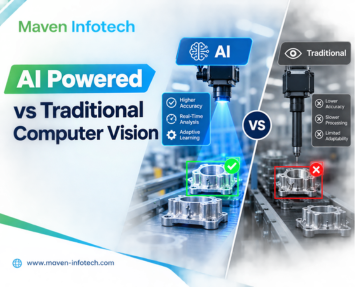
AI-Powered Computer Vision Development vs. Traditional Computer Vision Solutions: Which Is Better for Manufacturing Quality Control?
Manufacturing quality control is becoming increasingly automated as companies look for faster, more accurate, and more consistent ways to identify product defects. Computer vision technology has emerged as an important part of modern inspection systems, allowing cameras and software to inspect products without relying entirely on manual checks.
However, manufacturers often face an important question:
Should they use traditional computer vision or invest in AI-powered computer vision development for quality control?
The answer depends on the type of products being inspected, the complexity of defects, production conditions, and the level of flexibility required.
What Is Computer Vision in Manufacturing?
Computer vision uses cameras, sensors, image-processing software, and algorithms to analyze products during the manufacturing process.
A computer vision quality control system can inspect products for issues such as:
- Surface defects
- Incorrect dimensions
- Missing components
- Misalignment
- Scratches and cracks
- Color variations
- Assembly errors
- Packaging defects
- Label placement
- Product shape abnormalities
Instead of depending entirely on human inspectors, automated vision systems can continuously monitor products on a production line and identify potential quality problems.
What Is Traditional Computer Vision?
Traditional computer vision generally relies on predefined rules and image-processing techniques.
These may include:
- Edge detection
- Thresholding
- Pattern matching
- Shape recognition
- Contour detection
- Color analysis
- Image filtering
- Geometric measurements
For example, suppose a manufacturer needs to determine whether a component is correctly positioned on a circuit board. A traditional vision system can be programmed to compare the component’s position against predefined coordinates.
If the component is outside the acceptable range, the system can flag the product.
Advantages of Traditional Computer Vision
Traditional systems can be highly effective when the inspection environment is predictable.
Key benefits include:
1. Predictable performance
When defects and inspection conditions are consistent, rule-based systems can deliver reliable results.
2. Less training data
Traditional systems generally don’t require large datasets for model training.
3. Easier interpretation
The inspection rules are explicitly defined, making it easier to understand why a product was rejected.
4. Fast processing
Simple image-processing operations can often be performed quickly, which is important for high-speed manufacturing lines.
5. Suitable for straightforward inspections
Tasks involving fixed dimensions, positions, shapes, or colors can often be handled effectively using traditional approaches.
What Is AI-Powered Computer Vision?
AI-powered computer vision uses technologies such as machine learning and deep learning to analyze images and identify patterns.
Instead of defining every possible defect through individual rules, an AI model can be trained using examples of acceptable and defective products.
For example, a manufacturer could provide thousands of images containing:
- Good products
- Scratched products
- Cracked products
- Misaligned products
- Deformed products
- Contaminated products
The AI model learns visual patterns from this data and uses them to classify or detect defects in new images.
This makes AI-powered computer vision particularly useful when defects are difficult to describe using simple rules.
AI-Powered vs. Traditional Computer Vision
The two approaches are not necessarily competitors. In many manufacturing environments, they can complement each other.
| Factor | Traditional Computer Vision | AI-Powered Computer Vision |
|---|---|---|
| Rule-based inspection | Excellent | Possible |
| Complex defect detection | Limited | Strong |
| Training data requirements | Low | Higher |
| Adaptability | Lower | Higher |
| Fixed inspection conditions | Very suitable | Suitable |
| Variable products | More difficult | Better suited |
| Implementation complexity | Generally lower | Generally higher |
| Explainability | High | Can require additional analysis |
| Continuous improvement | Requires rule changes | Models can be retrained |
| Complex surface inspection | Challenging | Often better suited |
When Traditional Computer Vision May Be the Better Choice
AI isn’t automatically the right solution for every manufacturing inspection problem.
Traditional computer vision can be a practical option when the inspection criteria are clearly defined and rarely change.
For example, consider a production line where every product must have a specific hole diameter.
The system only needs to:
- Locate the hole.
- Measure its diameter.
- Compare it against acceptable limits.
- Pass or reject the product.
A traditional vision system may accomplish this efficiently without requiring a large AI training dataset.
Traditional computer vision can therefore be suitable for:
- Dimension measurement
- Presence/absence detection
- Fixed-position inspection
- Barcode and text recognition
- Simple alignment checks
- Basic shape detection
- Consistent color inspection
When AI-Powered Computer Vision May Be Better
AI-powered computer vision becomes particularly valuable when visual inspection involves complex or variable defects.
Consider a manufacturer inspecting painted metal components.
A traditional system might struggle to create rules for every possible combination of:
- Scratches
- Uneven coating
- Surface marks
- Texture differences
- Small dents
- Lighting variations
An AI model can potentially learn these patterns from a sufficiently representative dataset.
AI-powered vision can be particularly useful for:
1. Surface Defect Detection
AI can be trained to recognize subtle surface abnormalities that may be difficult to define using traditional image-processing rules.
2. Product Classification
Manufacturers can use AI models to classify products according to different visual characteristics.
3. Complex Assembly Inspection
AI can help identify incorrect or incomplete assemblies where multiple components and configurations need to be considered.
4. Variable Manufacturing Conditions
Production environments can change because of lighting, materials, product variations, or equipment changes. AI-based systems can potentially be adapted through appropriate data and retraining.
5. Anomaly Detection
AI-based approaches can be used to identify unusual visual patterns that don’t necessarily correspond to a predefined defect rule.
The Importance of Training Data
One of the biggest differences between traditional and AI-powered computer vision is the role of data.
An AI inspection system is only as good as the data used to develop and evaluate it.
Manufacturers may need images representing:
- Normal products
- Different defect types
- Different defect sizes
- Different lighting conditions
- Different product variants
- Different production batches
- Real-world variations
The dataset should also be properly labeled and representative of the conditions under which the system will operate.
Poor-quality or overly limited training data can result in unreliable predictions.
Accuracy Isn’t the Only Consideration
When evaluating computer vision for manufacturing quality control, accuracy should not be considered in isolation.
Manufacturers should also evaluate:
False Positives
A good product is incorrectly classified as defective.
Too many false positives can increase waste and unnecessary manual inspections.
False Negatives
A defective product is classified as acceptable.
This can be particularly important when defects could affect safety, performance, or customer satisfaction.
Processing Speed
The system needs to analyze products quickly enough to keep up with the production line.
Integration
The vision system may need to communicate with:
- PLCs
- Robotic systems
- Manufacturing execution systems
- Industrial databases
- Quality management systems
- Production monitoring platforms
Scalability
A solution should ideally be capable of supporting additional products, production lines, or inspection requirements when needed.
Why a Hybrid Approach Can Make Sense
Manufacturers don’t necessarily have to choose between traditional and AI-powered computer vision.
A hybrid computer vision system can combine both approaches.
For example:
Traditional computer vision can handle:
- Measurements
- Geometric checks
- Fixed-position verification
- Barcode detection
while AI-powered vision handles:
- Surface defects
- Complex visual classification
- Anomaly detection
- Variable product characteristics
This approach can allow each technology to perform the tasks for which it is best suited.
Key Factors to Consider Before Choosing a Solution
Before implementing an automated visual inspection system, manufacturers should consider the following:
Product Characteristics
Are the products identical, or are there many variations?
Defect Complexity
Can defects be described using simple rules, or are they visually complex?
Production Speed
How many products need to be inspected per minute?
Available Data
Are sufficient images of defective and non-defective products available?
Environmental Conditions
How much do lighting, positioning, materials, and other conditions vary?
Cost of Errors
What is the business impact of missing a defective product versus rejecting a good one?
Future Requirements
Will inspection requirements change as new products or defect types are introduced?
AI-Powered Computer Vision vs. Traditional: Which Should Manufacturers Choose?
There is no universal answer.
Traditional computer vision can be an effective solution for structured, predictable, rule-based inspections where the environment and inspection criteria remain relatively stable.
AI-powered computer vision can be advantageous when manufacturers need to detect complex defects, handle product variation, identify subtle visual patterns, or adapt to changing inspection requirements.
In many cases, the most practical strategy is not choosing one technology exclusively but designing a computer vision quality control system that combines traditional image processing and AI where appropriate.
The right approach should be determined by the specific inspection requirements, available data, production environment, performance targets, integration requirements, and overall cost of implementation.
Conclusion
The evolution from traditional computer vision to AI-powered computer vision is giving manufacturers new possibilities for automated quality inspection. AI can make visual inspection more adaptable and capable of handling complex patterns, while traditional computer vision remains valuable for fast, deterministic inspection tasks.
For manufacturers considering automation, the goal shouldn’t simply be to choose the newest technology. Instead, the focus should be on selecting the right computer vision approach for the specific quality control problem.
When properly designed and integrated into the production workflow, computer vision can help manufacturers improve inspection consistency, reduce manual effort, identify defects earlier, and build more data-driven quality control processes.